Reflection Sunday 12 November

Matt 25:1-13

Am I ready for God? This passage is connected to ideas of ‘judgement’ or ‘end times’ which was a notion very popular in the 1st century, including amongst Christians. The ‘kingdom of heaven’ is associated with life after death. God is coming and we do not know the ‘day nor the hour’. During the 1st century, the world was expected to end very soon – so one had to be ready. We still believe that God will come but after 2000 years of waiting, we know we could wait a while longer. Obviously it is also important for each of us to be prepared for when we die – and the judgement  that we believe that comes at that time.

A different understanding of the ‘kingdom of heaven’ is the ‘reign of God’. What if we think that the reign of God could be made manifest, in part, now? Surely that is a community, a place that is guided by justice, love and compassion. Heaven knows we need that right here on Earth, right now. So a more immediate understanding of this passage might be to ask, am I acting in a way that can help God’s reign be present now? Do I care for those on the margins of society, on the margins of my life? Do I help those with no voice, to speak? Do I use my God-given gifts and talents to build community? Am I welcoming to strangers? Do I laugh at myself and my faults – there I go again? Do I appreciate the small wonders of every day – like waking up, the sun, sky clouds, trees, birds, plants, people – and am I sufficiently awake to realise that God is talking to me, guiding me through them?

May we each be ready with the wisdom and grace to greet every day as the miracle it can be if we truly open our eyes. In so doing, we will build peace.

Reflection Sunday 5 November

Matthew 23:1-12

With the responsibility of significant decisions and so much attention as a consequence, a challenge for a leader is to stay grounded, whether that leader is political or religious. ‘Do as I say, not as I do’ is not inspiring advice. If what I tell you is so great, so meaningful, what aren’t I following my own advice? That’s why another saying is ‘actions speak louder than words’. This mindset is all the more true when it comes to an individual expressing their faith. For my faith to be meaningful, my expressions of faith should match what I believe my faith to be. My faith in God should lead to worshipping God – not me. 

Is my faith about what others see me do? Is it about being showy? Faith should be lived (and thus the name of this blog) and an essential part of that faith is humility. The humble person is confident in their God-given gifts, they do not need to draw attention to themselves. Ideally, I should use my God-given gifts to build community.

An interesting point to note in this passage is that Jesus does not criticise the teaching of the scribes and Pharisees – but that they do not live their teaching. It is easy to judge and criticise but Jesus is asking us to be discerning. When I hear good teaching, it is my job to live it out; not ignore good teaching because it is poorly lived. Another facet of this passage is that I shouldn’t judge – I should be aware of the plank in my own eye, acknowledging the challenge of living my faith every day.

Reflection Sunday 29 October

Matt 22:33-40

This Gospel passage has so much in it that its familiarity could mean we gloss over its deeper meanings. The commandment to love God ‘with all your heart, all your soul and all your mind’ seems to me to be a full time job in itself. Another way of putting it is to be completely caught up in loving God. I know I fall well short of that mark.

Something that might help me more closely meet the commandment is further exploration of how one can ‘love God’. While one might focus on prayer and reading scripture and the like, we can love God by loving God’s creation.Those of us in the developed world need to carefully examine our daily actions and the way they work with or harm God’s creation. Living and loving ethically has significant consequences for ourselves and future generations.

We also love God’s creation in the second part of the passage – by loving our neighbour, as ourselves. When we think about the armed conflicts around the world, as well as community relations and the way those on the margins are treated both in real life and the digital space, we have a long way to go in loving our neighbour.

Peace is not the absence of war. Peace begins in each person’s heart. So I must be at peace with myself before I can be at peace with anyone else. Thus I suggest that the problem is that we do love our neighbour as ourselves but we love ourselves so poorly that our relationships with others are soured. So let us each take time to appreciate ourselves, all of our God-given gifts and talents. As I begin to be more at peace with all that God has done in me, my relationships with others will be more selfless and truly loving – and so more fully honour the God in whom I live and move and have my being.

Love wins

Beset

on many sides:

brothers struggling to live out

his clear passionate vision,

not content to be guided

by the Spirit,

wanting specific direction;

Church authorities

mindful of the future

and maintaining the good work

begun

along with a liberal dose of

control.

Francis has a rule

that is accepted.

He returns to his quest

to touch hearts

with the love of Jesus,

of God,

despite being weighed down

by his own physical frailty

such as TB and trachoma.

He returns to Greccio

to re-enact the Christmas story

in a way

that touched all present

and reverberates

down through eight centuries

to today.

On fire

with God’s love

of creation

of humanity,

Francis powerfully shared

that message:

God loves all creation

including

each one

of us.

Love incarnated

We gather

for Eucharist,

all included.

Love celebrated

stretching back two millennia, yes,

and how it is lived

now,

every day:

married,

single,

celibate,

young,

less so;

powerful,

simple,

profoundly moving:

celebration of love incarnated.

In my human imperfection

with fire in my bones,

I say

“yes!”

to love

and living it

every day.

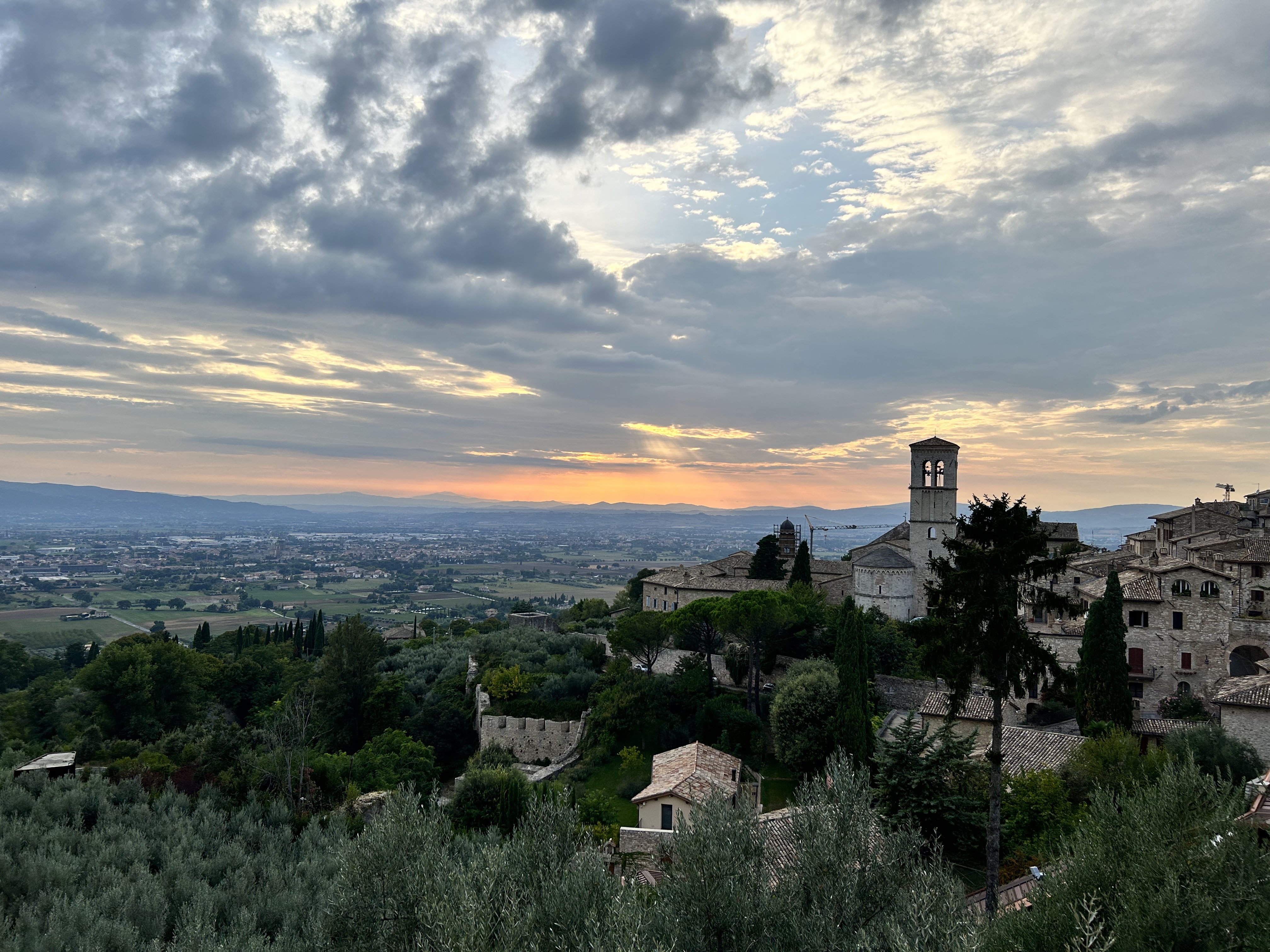
Awestruck

Fortunate to have witnessed

the sunset tableau

from the Santa Chiara piazza

previously

I wander down to see

but I’m still awestruck

at the unique combination

of pinks, greys, blues and greens

from sky

and cloud

and trees and shrubs

and sun,

along with the human landscape.

God is always with us

but such a scene

makes me feel that

God’s immanence

is imminent.

This leaves me humbled,

grateful.

As I sit

an unconscious hurt

is creeping into awareness.

This place,

this scenery

begins to heal me,

helps me to feel more whole

and deeply privileged

to simply be here.

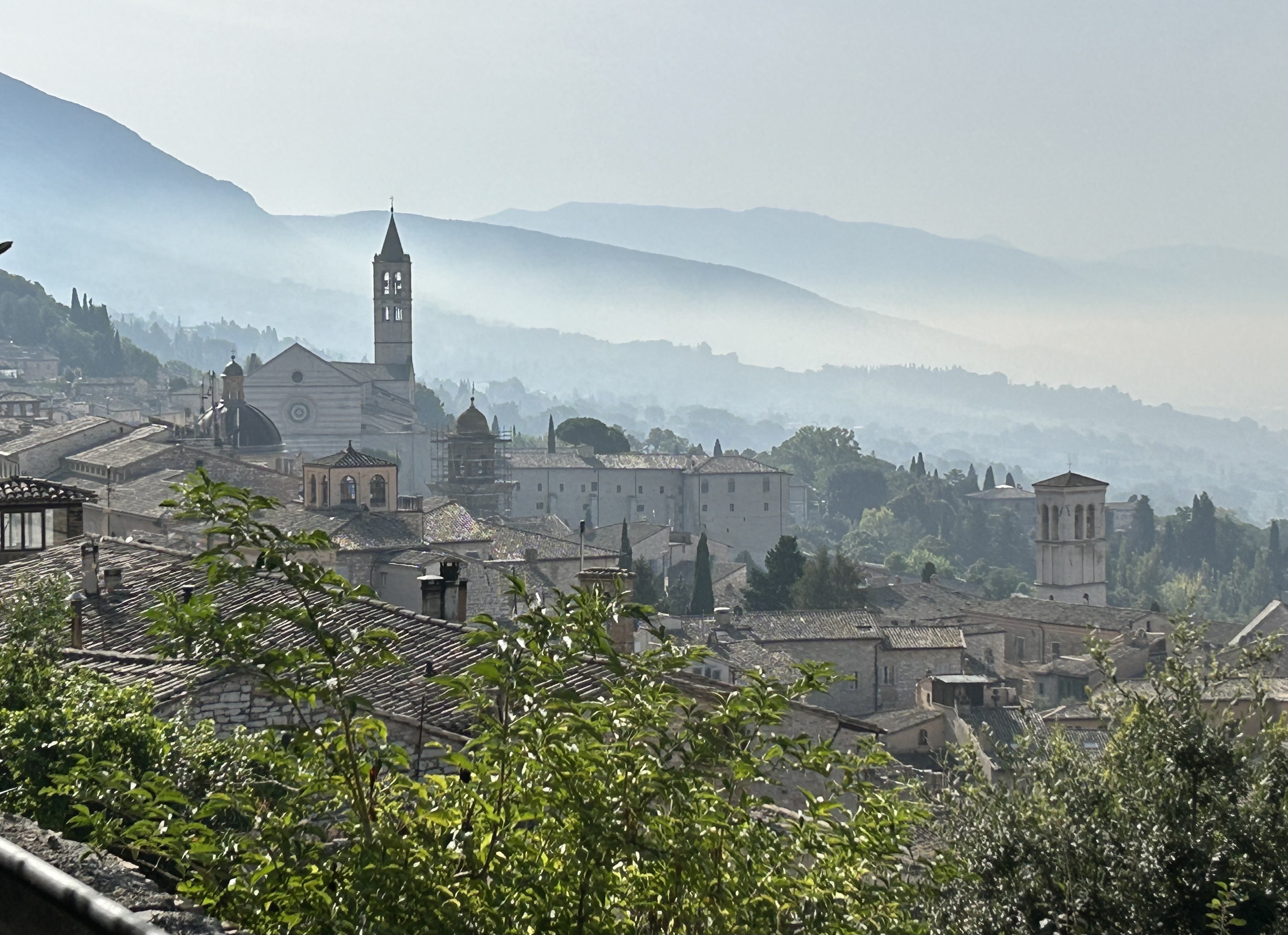
Sunday, with bells

Standing on a rooftop

the Spoleto valley

before me.

I stand, transfixed

by the interplay

of sun, clouds, mist.

The scene is

soft, peaceful

and bright.

Almost on cue

bells sound

stirring the heart

further,

all giving praise

and glory to God.

Glimpses

We take a short walk

to the reputed home of St Francis.

Any of their family difficulties

resonate through the centuries

as we each have our own struggles:

with parents,

with children.

When is a line crossed

unforgivable?

All with the backdrop

of a gorgeous Umbrian day

whose warmth and beauty

are palpable reminders

of the peace

of this wondrous place,

Assisi.

Thisness

Birds quickly dart

this way and that,

Ten or more

interplay:

dodging,

twirling,

swooping

centimetres

from the ground,

from the trees, 

from each other,

joyously alive.

Majestic trees

grow up and out.

Light bark,

green foliage

interlink

to form

a shady canopy

from the sun

and the brilliant blue

of the sky.

Don’t forget the blue

of the sea

on this magnificent 

spring day.

All just a sliver

of thisness

on display:

everywhere,

all of the time.

Each organism,

each facet,

living or not,

doing what it

Is supposed to do

in God’s creation.